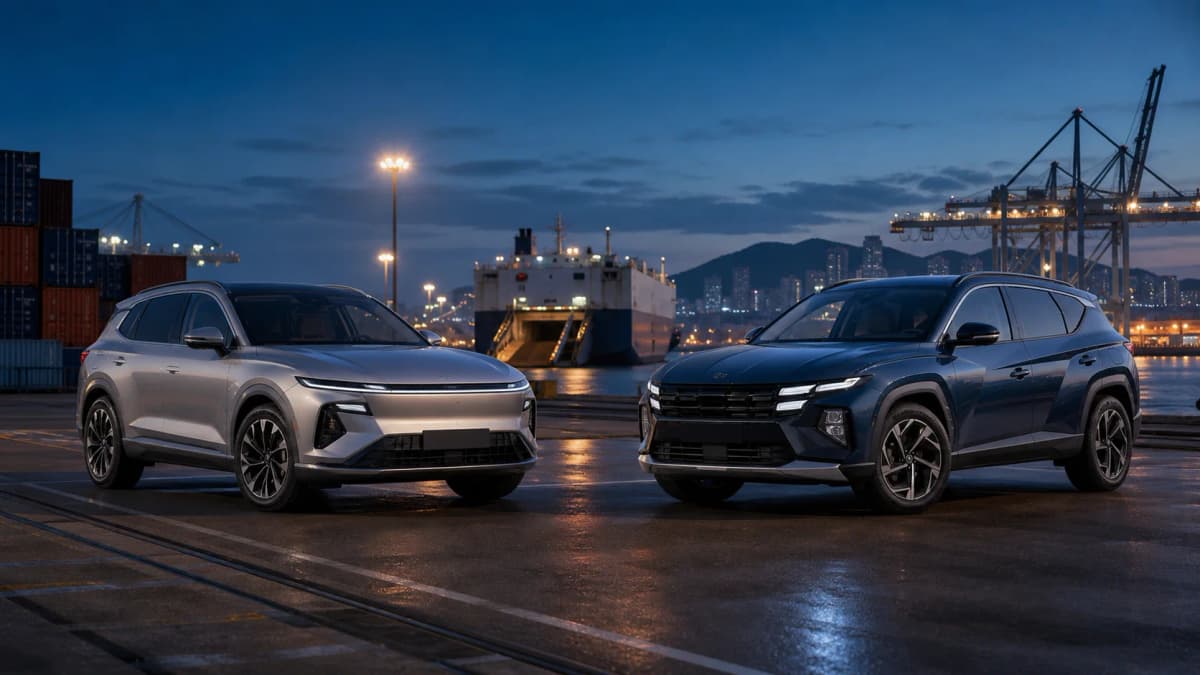
The short answer: there is no permanent winner by brand. In this snapshot the Kia listing is €494 lower, but the cars differ in engine, mileage and condition. In a real import, inspection quality, proof of origin and expensive specification-specific parts can change the result much faster than the badge.
01 · Market snapshot
Listings overlap far more than the badges suggest
We used two currently available, recently inspected Korean listings as a reference—not a statistical sample. The Kia Sportage is around 4.4% cheaper, but it has more kilometres and a diesel engine. The Tucson is petrol and has nearly 29,000 km less mileage. That is exactly why an average-price winner would be misleading.[4],[5]
| Model | Year · fuel · mileage | Korean price | Published equivalent |
|---|---|---|---|
| Kia Sportage | 2021 · diesel · 75,365 km | ₩17 750 000 | €10 707 |
| Hyundai Tucson | 2021 · petrol · 46,693 km | ₩18 900 000 | €11 201 |
A market snapshot, not an average. Euro equivalents are those published with each listing and exclude freight, tax and services.
02 · The real import cost
Origin paperwork can be worth more than the gap between two listings
The EU–South Korea agreement removed customs duties on almost all products, but preference is not automatic merely because the badge is Korean. The vehicle must satisfy the origin rules and carry a valid declaration. For consignments above €6,000, the agreement generally requires an origin declaration from an approved exporter. Bulgarian import VAT is 20%, and the taxable base includes customs value and any applicable duty.[1],[2],[3]
Illustrative calculation
€10,700 vehicle + €2,000 freight and insurance = €12,700 customs value
Accepted preference
- Customs duty
- €0
- VAT at 20%
- €2 540
- Subtotal
- €15 240
No accepted preference
- Customs duty
- €1 270
- VAT at 20%
- €2 794
- Subtotal
- €16 764
Paperwork difference: €1 524
The non-preference scenario uses a 10% working passenger-car rate solely to illustrate the difference. The actual rate depends on the exact TARIC code, origin and documents. Port, agent, product, technical and registration costs are excluded. Confirm the calculation with a customs representative before purchase.
03 · Parts and maintenance
Cheap routine service, expensive specification mistakes
Hyundai and Kia share platforms and many mechanical components. That helps with routine service, but it does not make every part interchangeable. Lamps, radars, infotainment, wiring and body panels vary by model, market and trim. Parts ordering should start with the VIN, not a photograph.[6],[7],[8],[10]
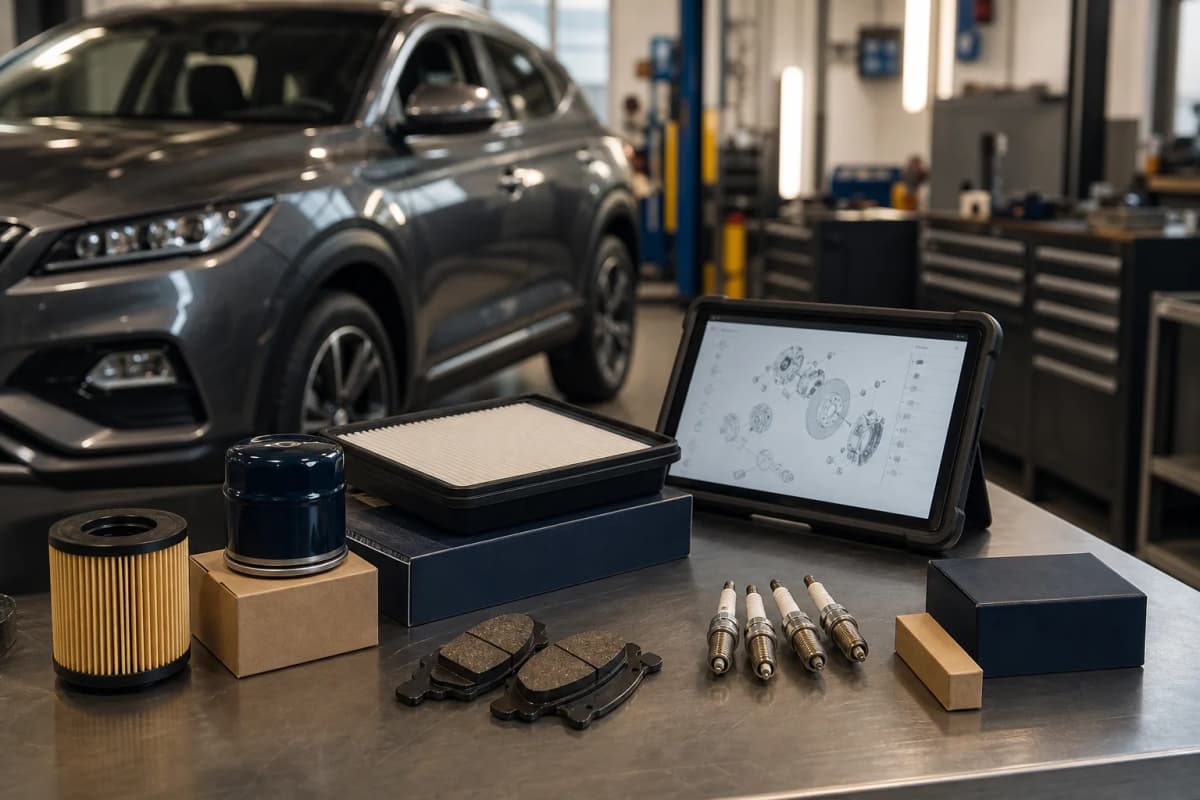
Shared OEM oil filter
$6.30
Hyundai/Kia no. 26300-35505
Tucson front pads
$82.33
OEM kit for one specific configuration
Front headlamp
$509–$1,240
Example Tucson/Sportage range by specification
These are current catalogue prices from US online OEM retailers, before freight and tax. They show the scale of the risk; they do not guarantee compatibility or a Bulgarian price for a Korean-market VIN.
04 · What owners report
Reddit is useful for questions, not a final verdict
We reviewed owner and buyer discussions, including a Bulgarian question about a Korean-market Sportage. Three themes recur:[9],[10]
A Korean-market warranty may not be honoured by the European dealer network.
Infotainment and connected services may remain region-locked even when the mechanical package is familiar.
Many service and powertrain parts are shared, while body and electronic parts are often specification-specific.
These are anecdotes, not controlled research. Use them to build a checklist, then confirm each point by VIN with a workshop and importer.
05 · A practical choice
When Kia, when Hyundai?
Choose the Kia when…
- the equivalent listing is meaningfully cheaper after matching mileage and trim;
- the inspected VIN has clear history and accessible specification-specific parts;
- you prefer the actual equipment package, not merely the styling.
Choose the Hyundai when…
- the individual car has a cleaner history or materially lower verified mileage;
- the exact model and configuration are more common in Bulgaria and Europe;
- local availability of lamps, radars and panels is stronger.
Six checks before a deposit
Compare at least 5–10 cars with the same engine and equipment level.
Request the Korean condition sheet, insurance history and underbody photos.
Confirm the preferential-origin declaration before payment.
Check lamps, glass, radar, infotainment and service parts by VIN.
Budget for tyres, fluids, battery and the first service.
Compare registered all-in cost, not the listing price.
The final answer
The Kia is cheaper in this small market snapshot. In an actual purchase, a cleaner Hyundai with the right paperwork can easily cost less overall—and vice versa. The best value comes from the right individual car, proven origin and pre-checked maintenance support.
Search for a car in KoreaSources and methodology
Checked 1 August 2026. Listings and parts prices change. Reddit sources are used only to surface issues worth checking, not as evidence of frequency or reliability.
- [1]EU–South Korea trade agreement factsheetEuropean Commission · Access2Markets
- [2]Korea–EU FTA origin declaration guidanceKorea Customs Service
- [3]Bulgaria import requirements and 20% VATInternational Trade Administration
- [4]2021 Kia Sportage listing · ₩17.75mSSANCAR / Encar listing
- [5]2021 Hyundai Tucson listing · ₩18.90mSSANCAR / Encar listing
- [6]Hyundai/Kia oil filter 26300-35505 · $6.30HyundaiPartsDeal
- [7]2021 Hyundai Tucson headlamp pricesHyundaiPartsDeal
- [8]2021 Kia Sportage headlamp pricesKiaPartsNow
- [9]Bulgarian buyer discussing a Korean-market SportageReddit · r/kiasportage
- [10]Hyundai/Kia shared-parts owner discussionReddit · r/cars